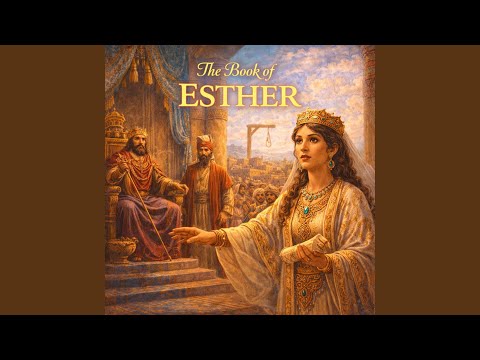
Esther 7King James Version
1So the king and Haman came to banquet with Esther the queen.
2And the king said again unto Esther on the second day at the banquet of wine, What is thy petition, queen Esther? and it shall be granted thee: and what is thy request? and it shall be performed, even to the half of the kingdom.
3Then Esther the queen answered and said, If I have found favour in thy sight, O king, and if it please the king, let my life be given me at my petition, and my people at my request:
4For we are sold, I and my people, to be destroyed, to be slain, and to perish. But if we had been sold for bondmen and bondwomen, I had held my tongue, although the enemy could not countervail the king's damage.
5Then the king Ahasuerus answered and said unto Esther the queen, Who is he, and where is he, that durst presume in his heart to do so?
6And Esther said, The adversary and enemy is this wicked Haman. Then Haman was afraid before the king and the queen.
7And the king arising from the banquet of wine in his wrath went into the palace garden: and Haman stood up to make request for his life to Esther the queen; for he saw that there was evil determined against him by the king.
8Then the king returned out of the palace garden into the place of the banquet of wine; and Haman was fallen upon the bed whereon Esther was. Then said the king, Will he force the queen also before me in the house? As the word went out of the king's mouth, they covered Haman's face.
9And Harbonah, one of the chamberlains, said before the king, Behold also, the gallows fifty cubits high, which Haman had made for Mordecai, who had spoken good for the king, standeth in the house of Haman. Then the king said, Hang him thereon.
10So they hanged Haman on the gallows that he had prepared for Mordecai. Then was the king's wrath pacified.
About Esther 7
At the second banquet, Esther makes her request. Her people and she herself have been sold to be destroyed. The king asks who dared. Esther answers, 'The adversary and enemy is this wicked Haman.' The king leaves the room in rage. Haman throws himself on Esther's couch to beg for his life. The king returns and sees it as an assault on his queen. Haman is hanged on the gallows he had built for Mordecai.
What happens here?
At the second banquet, the king asks Esther again for her request. She reveals herself as Jewish and names Haman as the man whose decree will destroy her people. The king steps outside in fury. Haman throws himself on Esther's couch to beg for his life. The king returns, sees this, and interprets it as assault. Harbona mentions that Haman has built a gallows for Mordecai. The king orders Haman hanged on it. The king's fury abates.
The big idea?
Esther speaks. Her willingness to name herself and name the threat is the act that turns the story. The weapon Haman built destroys him.
A line to remember
verse: "Then Esther the queen answered and said, If I have found favour in thy sight, O king, and if it please the king, let my life be given me at my petition, and my people at my request." (7:3) -- She links her life to her people's lives. Her survival and their survival are the same request.
Set the scene
Susa palace, the banquet chamber, around 474 BC. Wine, cushions, the king in a generous mood asking for the third time what Esther wants. She tells him. She names Haman. The king stands and walks out to the garden. Haman falls onto Esther's couch. The king returns and reads it as violation. A servant mentions the seventy-five-foot gallows standing at Haman's house, prepared for Mordecai. The king's decision takes one sentence. Haman is hanged on what he built.
Who's in it?
Esther -- finally speaking the thing she has been preparing to say; Ahasuerus -- moving from confusion to anger to decisive action; Haman -- stripped of every advantage in a matter of minutes; Harbona -- the servant whose single line about the gallows closes the trap.
Why it matters
This is the chapter where the concealment of chapter 2 pays off in the most direct way: the king cannot dismiss the threat to the Jews without dismissing the threat to his own queen. Esther's identity is her argument. Haman's downfall is swift and shaped entirely by his own construction: the gallows he built for Mordecai receives him instead.
For when you feel...
Esther carries everything she has held in silence since chapter 2 into this room. The speech is controlled and devastating. She does not shout. She does not plead. She names the stake clearly.